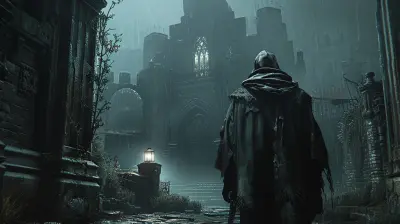
Top Games with Open-Ended Choices
29 July 2026
Imagine standing at a crossroads in a game world where every choice you make shapes not just the outcome but the entire journey. Open-ended choice games have exploded in popularity over the past decade. Why? Because we love control. We crave the freedom to do things our way, to craft personal stories, and to break the mold. These kinds of games don’t just give you a preset narrative path to follow — they hand you the pen and say, “You write it.”
In this deep dive, we’re going to explore the top games with open-ended choices — the ones that really get your brain buzzing and your conscience questioning. These aren’t just any old games. These are the crème de la crème that let you make real decisions with real consequences. Ready? Let’s dig in.
Why We Love Games With Open-Ended Choices
Before jumping into the list, let’s hit pause for a second. Why are games with open-ended choices so satisfying?Because they feel personal. The stakes are higher when your decision determines if a character lives or dies, if a city thrives or burns, if your comrades trust you… or betray you. You become emotionally invested, not just playing a game but living a story. Every twist feels like something you caused — because, well, you did.
Whether it’s playing the villain, the hero, or something in between, these games cater to what makes gaming great: unlimited possibility.
1. The Witcher 3: Wild Hunt
Developer: CD Projekt RedPlatform(s): PC, PS4, PS5, Xbox One, Xbox Series X/S, Nintendo Switch
Geralt of Rivia isn’t your typical knight in shining armor. In The Witcher 3, every choice you make — big or small — affects how the story unfolds. It's not just about slaying monsters. It’s about navigating gray moral areas. Save a cursed creature or kill it? Side with rebels or royalty?
What’s really special here is how subtle choices ripple across the world. Sometimes, you won't even see the consequences until many hours later. That ambiguity? That’s what makes the story feel so real.
You’ll often find yourself stopping mid-dialogue and thinking, “Wait… what would Geralt do?” That's storytelling done right.
2. Mass Effect Series
Developer: BioWarePlatform(s): PC, PS3, PS4, Xbox 360, Xbox One, Xbox Series X/S
When it comes to games with open-ended choices, Mass Effect is legendary. Every choice you make — from how you treat your crew to which species you save or sacrifice — builds your version of Commander Shepard.
The genius of Mass Effect lies in its continuity. Your decisions carry over from one game into the next, meaning the relationships and outcomes evolve over multiple titles. It’s like binge-watching a TV series where you write the script — with a ton of space guns and awkward alien flirting.
And let’s not forget the infamous ending debate. Love it or hate it, you can’t deny how much those choices meant to players around the world.
3. Fallout: New Vegas
Developer: Obsidian EntertainmentPlatform(s): PC, PS3, Xbox 360
Fallout: New Vegas feels like a giant “choose your own adventure” book plopped into a post-apocalyptic wasteland. You’re not just surviving — you’re deciding how the future of the Mojave Desert will unfold.
Will you back the militaristic NCR? Side with the mysterious and brutal Caesar’s Legion? Or maybe you just take control yourself and say “screw it” to everyone else?
The beauty is that New Vegas doesn’t funnel you down a moral "good vs. bad" path. It throws you into the deep end and lets you swim — or drown — on your own terms. Every faction has shades of gray, and the “right” choice depends entirely on your values.
4. Detroit: Become Human
Developer: Quantic DreamPlatform(s): PC, PS4
Detroit: Become Human is a cinematic experience that plays like an interactive movie. You control three androids, each with their own tangled path — and trust me, those paths can lead to some wildly different places.
This game is all about choices. Nearly every decision changes the outcome of the story in real-time, resulting in multiple endings and branches. You might spark a peaceful revolution or trigger all-out war. Characters can live, die, fall in love, or betray each other — all depending on you.
What really sets it apart? How deeply it makes you reflect on humanity, morality, and freedom. It’s like Black Mirror meets Blade Runner, with you in the director’s chair.
5. Divinity: Original Sin 2
Developer: Larian StudiosPlatform(s): PC, PS4, Xbox One, Nintendo Switch
If you love tactical combat, rich lore, and the kind of storytelling that responds to your every move, then Divinity: Original Sin 2 is your dream game.
This is a game where you can kill a key NPC and lock yourself out of major storylines — and the game won’t stop you. In fact, it leans into it. Want to play as an undead skeleton who hides his true identity under a hood? Sure. Want to romance a lizard prince while undermining a religious empire? Go for it.
The freedom here is mind-blowing. The world is so interactive that even your companions might turn against you depending on your choices. Every playthrough feels truly unique.
6. Red Dead Redemption 2
Developer: Rockstar GamesPlatform(s): PC, PS4, Xbox One
Arthur Morgan’s journey in Red Dead Redemption 2 is one of the most emotionally gripping narratives in gaming — and it’s one heavily shaped by your decisions.
Your honor level (good vs. bad) affects dialogues, relationships, and the ending. You can be the noble outlaw, helping strangers and trying to find redemption… or become a cold, hard gunslinger leaving chaos in your wake.
The choices here aren't always spelled out either. Sometimes it's about what you don’t do: walking away from a robbery, sparing someone’s life, helping someone on the side of the road. It all adds up, culminating in a finale that hits hard — depending on the kind of man you chose to make Arthur.
7. Disco Elysium
Developer: ZA/UMPlatform(s): PC, PS4, PS5, Xbox Series X/S, Nintendo Switch
This isn’t just a game — it’s an existential fever dream wrapped in a murder mystery. Disco Elysium skips combat entirely in favor of deep role-playing and inner monologue.
You play as a washed-up detective piecing together his identity while solving a case. The twist? Your mind is a battlefield of different voices — some logical, others wild — constantly bickering, arguing, pushing you in different directions.
Every decision, from what clothes you wear to how you talk to a child, can influence the outcome of the story. And the game remembers them, weaving each choice into a story that feels deeply personal and sometimes uncomfortably real.
8. Dragon Age: Inquisition
Developer: BioWarePlatform(s): PC, PS3, PS4, Xbox 360, Xbox One
Bioware really knows how to do choices. In Dragon Age: Inquisition, every conversation, companion quest, and battlefield decision shapes the fate of Thedas.
Who you romance, who you crown as rulers, which factions you strengthen — it’s all in your hands. And these aren't just cosmetic decisions either. They influence everything from major political alliances to the ending you get.
It’s the kind of game where halfway through, you’ll stop and think, “Did I just make a huge mistake?” And that tension? That’s what makes it so powerful.
9. The Elder Scrolls V: Skyrim
Developer: Bethesda Game StudiosPlatform(s): PC, PS3, PS4, Xbox 360, Xbox One, Nintendo Switch
Let’s be honest — you’ve probably played Skyrim at least once. And even if you haven’t, you’ve definitely heard about it. One of the main reasons people keep coming back? The freedom.
You can be whoever you want in this world. A warrior, mage, thief, assassin, werewolf, vampire… or just a wanderer picking flowers and yelling at dragons.
Join the Dark Brotherhood, lead the Thieves Guild, become the Arch-Mage — or ignore all of it and just fish. The game doesn’t judge. It lets you create your own story, and that's what makes it endlessly replayable.
What Makes a Game’s Choices Truly “Open-Ended”?
Not all choices in games are created equal. Some games trick you with “illusion of choice” — you click something different, but it all ends the same way. That’s not what we’re talking about.Open-ended choice games give you:
- Multiple, meaningful outcomes
- Real consequences for your actions
- Branching narratives
- Character reactions and changing relationships
- World-state changes that persist
Doesn’t matter if it’s saving a town or picking what food to eat at a campfire — when the game acknowledges your choices in a tangible way, that’s when the magic happens.
The Future of Open-Ended Gaming
With AI and procedural storytelling getting better, open-ended choice games are only going to grow. Developers are already experimenting with games that learn from your behavior and adapt the narrative on the fly. Think of it as your own personalized Netflix series — but interactive.Games like Baldur’s Gate 3 are already pushing the boundaries, giving players thousands of narrative combinations and dynamic relationship systems. And if the industry keeps heading in this direction? Buckle up — it's going to be wild.
Final Thoughts
Games with open-ended choices are more than just entertainment. They’re interactive playgrounds for our ethics, our creativity, and our imaginations. They ask questions that books and movies can’t: “What would you do?” And once you dive into that kind of experience, it’s hard to go back to linear storytelling.So, next time you pick up the controller or sit down at your keyboard, think twice before you rush through dialogue or skip a moral decision. After all, in these worlds, your choices actually matter.
all images in this post were generated using AI tools
Category:
Game RankingsAuthor:

Brianna Reyes