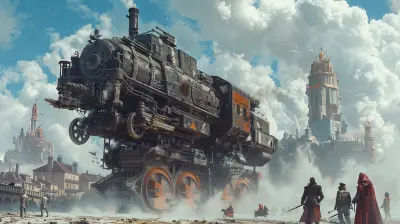
Games That Revolutionized the Industry
5 April 2026
Gaming has come a long way from pixelated plumbers and 8-bit dragons. Today, it's a multi-billion-dollar industry that sits comfortably alongside film, music, and tech. But it didn’t just happen overnight. Certain landmark titles didn't just raise the bar—they rewrote the rules, smashed ceilings, and paved the way for everything that came after.
In this article, we’re going to take a nostalgic-yet-critical look at the games that genuinely revolutionized the industry. These are the games that didn’t just sell well—they changed the game (pun totally intended).
Let’s dive into the digital hall of fame.
Pong (1972) — The Dawn of Video Games
Let’s start with the OG. Pong might look laughably simple by today’s standards—two paddles, a dot, and a bleep every time someone scores. But back in 1972? This was revolutionary.Created by Atari, Pong wasn’t the first video game ever made (shout out to “Tennis for Two” and “Spacewar!”), but it was the first one that truly caught fire with the public. It transformed video games from a nerdy experiment into a viable commercial product.
Why it was revolutionary:
- It kickstarted the arcade craze.
- Turned gaming into a public, social activity.
- Birthed one of the world’s biggest entertainment industries.
Without Pong, we wouldn’t have Red Dead Redemption or Fortnite. Period.
Super Mario Bros. (1985) — The Platformer Blueprint
When Super Mario Bros. dropped on the NES in 1985, it wasn't just a game—it rewired our brains. Before Mario, games were often short, clunky, and lacking a sense of progression. Mario introduced the idea of levels, secrets, and tight responsive controls.This was the birth of the modern platformer. And let’s be honest: who hasn’t hummed that iconic theme song?
Why it changed the game:
- Defined side-scrolling mechanics.
- Introduced tight control schemes still mimicked today.
- Made gaming accessible and fun for everyone, not just hardcore nerds.
This game didn’t just save Nintendo—it saved the entire gaming industry after the crash of 1983.
Doom (1993) — FPS Goes Mainstream
It’s no exaggeration to say that Doom invented how we shoot things in games. Sure, Wolfenstein 3D came a year earlier, but Doom brought speed, blood, and modding culture into the mix.You weren’t just playing a game. You were in the game. Fast-paced 3D movement, grotesque monsters, and over-the-top weapons made Doom a phenomenon.
Game-changing features:
- Pioneered the first-person shooter genre.
- Introduced game modding on a large scale.
- Networked multiplayer? Yeah, Doom did that in the early '90s.
We owe every headshot and health bar today to Doom’s DNA.
The Legend of Zelda: Ocarina of Time (1998) — Masterclass in 3D Adventure
Ask a gamer to name the greatest game of all time, and Ocarina of Time will come up. Not because it had the best graphics or deepest story, but because it nailed how immersive a 3D adventure could be.It wasn't just about swinging swords—it was about puzzles, exploration, time travel, and feeling like you were part of something bigger.
What made it stand out:
- Perfected Z-targeting (a lock-on system still used today).
- Fluid camera control in a 3D space—revolutionary at the time.
- Emotional storytelling that didn’t rely on dialogue alone.
This wasn’t just a game, it was a quest—one that aged like fine wine.
Half-Life (1998) — Storytelling Reimagined
In the same year as Ocarina, Valve dropped a bombshell with Half-Life. It was gritty, it was smart, and it didn’t stop for a cutscene. That alone was groundbreaking.Most games would pause to tell the story. Half-Life let it unfold around you. That immersive, seamless storytelling? You can thank Gordon Freeman for that.
Why it mattered:
- No cutscenes — story and gameplay were fully integrated.
- Set a new bar for environmental storytelling.
- Influenced every narrative-driven FPS that followed.
Even today, developers look to Half-Life when crafting immersive game worlds.
Grand Theft Auto III (2001) — The Sandbox Revolution
Before GTA III, open-world games existed—but they never felt truly alive. Rockstar changed all that with Liberty City, a living, breathing sandbox full of chaos and freedom.You weren’t just completing missions. You were stealing cars, running from cops, and choosing your own path in a world that didn’t hold your hand.
Why it changed the industry overnight:
- Brought open-world gameplay to the mainstream.
- Introduced dynamic NPCs and missions.
- Mixed cinematic storytelling with player freedom.
It showed that games could be both deep and outrageous. And the industry took notes—just look at every open-world game after 2001.
World of Warcraft (2004) — MMOs Made Easy (And Awesome)
MMORPGs used to be a niche thing—clunky, confusing, and full of grind. Then World of Warcraft landed, and suddenly millions of people were raiding dungeons together.You could work a 9-to-5, come home, and still be a hero in Azeroth.
Why WoW was a juggernaut:
- Made MMOs accessible to casual players.
- Set the gold standard for raids and guilds.
- Created a vibrant, player-driven economy and culture.
WoW wasn’t just a game—it was a second life for millions.
Minecraft (2011) — Play Your Way
Who would’ve guessed that a blocky indie game would become the best-selling video game of all time? Minecraft turned gaming into a playground of pure creativity.There were no rules. No set goals. Just endless blocks and your imagination.
Why it flipped the script:
- Encouraged creative freedom like never before.
- Blended survival, building, and adventure seamlessly.
- Empowered kids and adults to become creators, not just players.
Minecraft showed that graphics don’t matter—vision does.
Fortnite (2017) — Live-Service Gaming Done Right
Love it or hate it, Fortnite isn’t just a game. It’s a platform, a concert venue, and a cultural event. What started as a simple battle royale became a way to gather, dance, and watch Travis Scott perform mid-firefight.More importantly, it perfected the live-service model.
How it changed the ecosystem:
- Pioneered the battle pass economy.
- Constant updates kept the game fresh.
- Blended pop culture with gameplay effortlessly.
Fortnite redefined what it means to be a “live game.” It's part game, part social hub, part fashion show.
The Witcher 3: Wild Hunt (2015) — RPGs, Evolved
When people say a game has “meaningful choices,” nine times out of ten, they’re referencing The Witcher 3. CD Projekt Red created a world so detailed, rich, and morally gray that even side quests stabbed you in the feels.No fetch quests here—only heartbreak, tough calls, and beautifully written lore.
Why it raised the bar:
- Complex world-building with adult themes.
- Side quests richer than most main stories.
- Proved single-player RPGs could still dominate.
It wasn’t just a game. It was an experience—the kind that lingers long after the credits roll.
Honorable Mentions
Let’s give a quick nod to a few other titles that shook things up:- Tetris (1984) – Addictive, timeless, and everywhere.
- Metal Gear Solid (1998) – Blended stealth gameplay with cinematic storytelling.
- Portal (2007) – Proved puzzle games could be funny, deep, and physics-driven.
- Dark Souls (2011) – Created a whole subgenre of brutally hard but incredibly rewarding gameplay.
What Do These Games Teach Us?
These groundbreaking games didn’t just sell millions—they introduced new ideas. They pushed boundaries, defied expectations, and reminded us why we fell in love with gaming in the first place.They show that innovation comes in many flavors:
- A new control scheme.
- A fresh visual style.
- A different way to tell stories.
- A bold mechanic that hadn’t been explored.
Sure, not every game can be revolutionary. But these ones? They were lightning in a bottle.
Final Thoughts
You know, it’s easy to take today’s games for granted. Massive open worlds, seamless multiplayer, jaw-dropping graphics—these things are normal now. But the games we just talked about? They made all of that possible.Next time you hop into a battlefield, build a castle brick-by-brick, or lose yourself in an RPG, give a quick nod to the legends that paved the way.
Because without them, who knows what the gaming universe would look like?
all images in this post were generated using AI tools
Category:
Game RankingsAuthor:

Brianna Reyes
Discussion
rate this article
2 comments
Astraea Jacobs
This article beautifully highlights the pivotal games that reshaped the industry. It’s fascinating to see how innovation continues to drive our passion for gaming.
April 8, 2026 at 3:57 AM
Brianna Reyes
Thank you for your thoughtful comment! I'm glad you enjoyed the article and found the impact of those games fascinating. Innovation in gaming truly keeps the passion alive.
Malia McLain
This article highlights pivotal games that reshaped the industry, showcasing their innovative mechanics and lasting impact. A thoughtful exploration of how these titles continue to influence gaming today.
April 5, 2026 at 4:09 AM
Brianna Reyes
Thanks for your thoughtful comment! I'm glad you found the exploration of these revolutionary games engaging. Their impact truly resonates in today's gaming landscape.