Tracing the Origins of Space Combat Games
9 January 2026
When you think about space combat games, what comes to mind? Giant starships firing laser blasts? Nimble starfighters dodging asteroids in high-stakes dogfights? Or perhaps massive galactic wars involving entire fleets? Space combat games have been a staple of the gaming world for decades, whisking players away to the stars for thrilling battles. But where did it all begin? Let’s take a journey through time and explore the origins of space combat games—from their humble beginnings to becoming one of the most iconic genres in gaming. 
The Birth of Space Gaming: The Early Days
Before we dive into the flashy, high-octane space combat games we see today, we have to go back—waaaay back. We’re talking about the 1960s and 1970s. Yep, the golden age of chunky arcade cabinets and rudimentary, pixellated gameplay.One of the first games that could arguably be called a space combat game was "Spacewar!" created in 1962 by Steve Russell and his team at MIT. Think of it as the granddaddy of every space combat game you’ve ever played. “Spacewar!” wasn’t some flashy, commercial product. It was a simple yet groundbreaking two-player battle game developed on a PDP-1 minicomputer. Players piloted two spaceships (referred to as "the needle" and "the wedge") and battled against each other while avoiding a deadly star at the center of the screen.
What made “Spacewar!” revolutionary? Its physics-based gameplay. Gravity wasn’t just a cool concept—it was integral to the game. Players had to master the art of thrusting and maneuvering, all while keeping one eye on their opponent and another on the looming black hole of doom. Doesn’t that sound stressful yet wildly fun?
“Spacewar!” marked the start of something big. It laid the groundwork for what space combat games could feel like: skill-based, strategic, and oh-so-addictive. 
The Arcade Boom: When Space Combat Took Flight
Fast forward to the late 1970s and early 1980s—the era when arcades ruled the gaming world. Space games weren’t just niche anymore. Developers saw their potential and began crafting titles that combined action, strategy, and the excitement of flying among the stars.Enter “Asteroids” (1979) by Atari. Now, I know what you’re thinking: “Asteroids? That’s not a space combat game!” But hold on—while it wasn’t a combat game in the traditional sense, “Asteroids” gave players a taste of what it felt like to pilot a spaceship in zero gravity, dodging incoming threats and blowing things to smithereens. The simple yet challenging gameplay, coupled with satisfying explosions, gave players the thrill of commanding their own ship (cue dramatic space music).
Shortly after this, space shooters like “Galaga” and “Defender” hit the scene. These games amped up the action, introducing mechanics like wave-based enemies and power-ups. They weren’t full-fledged “combat simulators,” but they had the spirit of space battles: high-energy, fast-paced, and filled with pew-pew laser sounds. 
The PC Revolution: Space Combat Simulation Emerges
As gaming tech evolved, so too did the complexity of space combat games. By the mid-to-late 1980s, personal computers had become more accessible, giving developers a chance to flex their creative muscles. This is when we started seeing the rise of space combat simulators. Yep, simulators! These weren’t your average button-mashing shooters. No, no, no—these games aimed to immerse players into the cockpit of a spaceship and simulate the real deal.One standout was “Elite” (1984), developed by David Braben and Ian Bell. “Elite” was more than a game—it was an experience. Players explored a vast procedurally-generated galaxy, engaging in trading, exploration, and (you guessed it) intense space combat. The game’s scope and ambition were jaw-dropping for its time, inspiring an entire generation of gamers and developers alike.
Then came “Wing Commander” (1990) from Origin Systems. If “Elite” was the quiet genius of the classroom, “Wing Commander” was the outrageously loud kid who loved attention—and gamers ate it up! It featured cinematic storytelling, engaging dogfights, and a sense of immersion that was off the charts. Suddenly, space wasn’t just a backdrop; it was the star of the show. 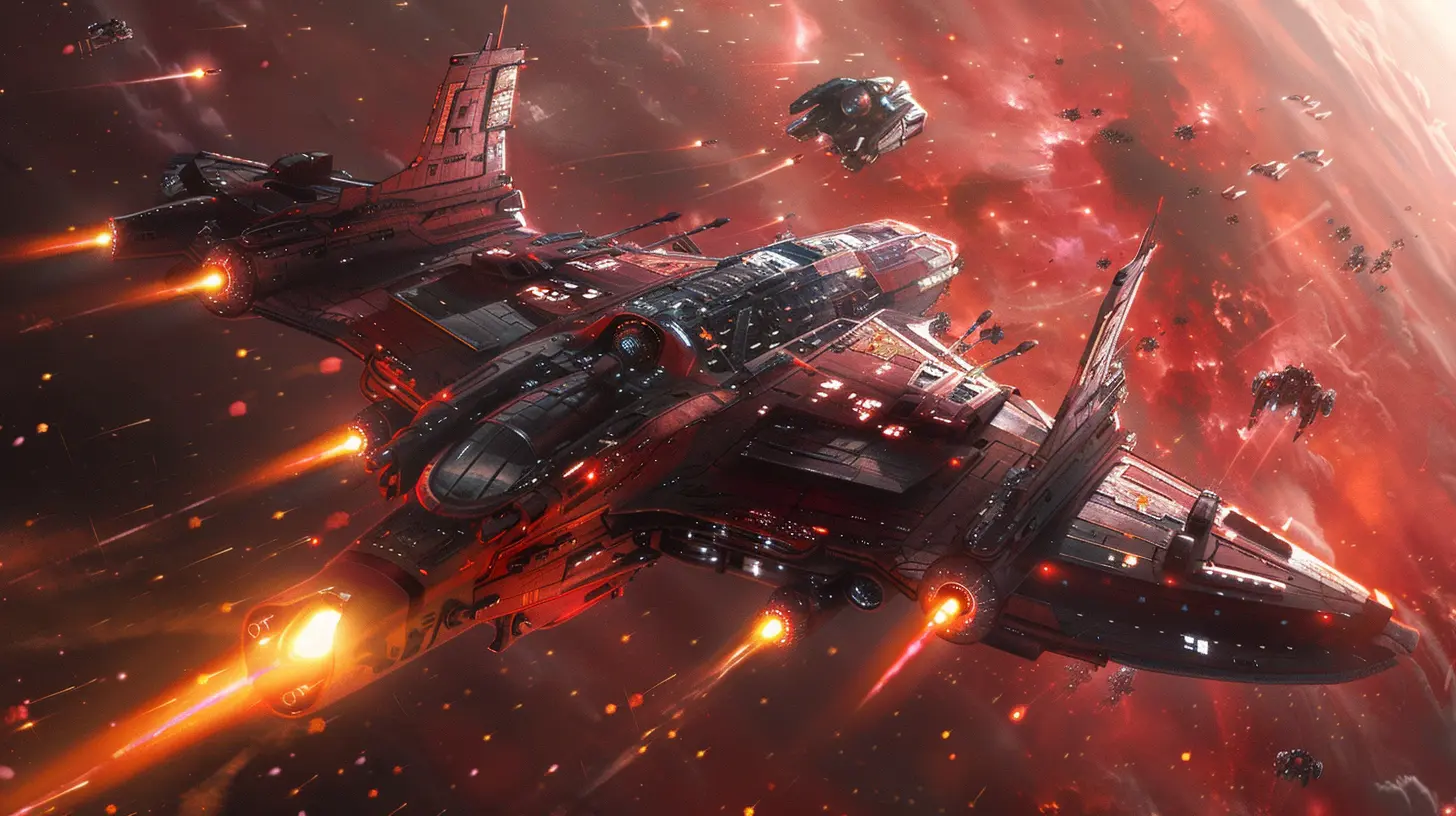
The Console Shift: Space Combat for the Masses
While PC gamers were living their best lives in the cockpit of starfighters, console gamers were also getting a taste of space combat. Titles like “Star Fox” (1993) on the SNES brought 3D space battles to life in a way that was accessible, fast-paced, and just plain fun. Who didn’t want to pilot a spaceship as a sassy fox with shades?During this time, space combat games started leaning into simpler, arcadey styles to fit the preferences of console players. Games like “Rogue Squadron” on the Nintendo 64 let fans of the Star Wars universe jump into iconic ships like X-Wings and battle the Empire directly—a dream come true for sci-fi enthusiasts.
The 2000s: When Space Got Massive
Ah, the 2000s—a decade where space combat games truly started to push boundaries. Game design began to evolve, and developers took things to the next level with richer worlds, in-depth lore, and bigger stakes. Titles like “Freelancer” (2003) bridged the gap between combat and exploration, offering players an open-world galaxy teeming with possibilities.Then there was “EVE Online” (2003)—a game that wasn’t just about space combat but about creating an entire economy and civilization in the stars. Sure, you could hop into battles, but players also found themselves waging wars over alliances, territories, and even betrayals. It was less “pew-pew” and more strategic, bringing a whole new flavor to space combat.
And who could forget “Halo: Combat Evolved” (2001)? While it wasn’t a space combat simulator per se, its vehicular space battles and epic sci-fi setting added a cinematic flair to combat, influencing how gamers and developers viewed intergalactic warfare.
Modern-Day Space Combat Games: A New Frontier
Fast forward to today, and space combat games are thriving like never before. From AAA blockbusters to indie gems, there’s a variety of space combat games catering to every type of gamer.For fans of realism, there’s “Star Citizen”—a crowdfunded juggernaut that aims to provide the most lifelike space exploration and combat experience possible. With intricate ship mechanics and breathtaking visuals, it’s like stepping into an actual sci-fi movie.
Then we have “No Man’s Sky” (2016), a game that blends exploration, creation, and combat into a seamless universe. When it first launched, it may not have lived up to the hype, but thanks to constant updates, it has become a beloved space adventure with the kind of dogfights that make you feel like a real space ace.
And who could ignore “Elite Dangerous” (2014), the spiritual successor to the original “Elite”? With its sprawling galaxy, intricate flight mechanics, and exhilarating battles, it continues to set the bar high for space combat simulators.
Why We Love Space Combat Games
So, what is it about space combat games that keeps us hooked? Is it the adrenaline rush of a perfectly executed barrel roll as lasers zip past you? The satisfaction of taking down a massive enemy ship against all odds? Or maybe it’s the sheer wonder of exploring a universe full of unknown dangers?Space combat games tap into our deepest desires for adventure, exploration, and challenge. They blend strategy with action, forcing us to think on our feet while delivering the kind of pulse-pounding action that dreams are made of. Plus, let’s face it—flying a spaceship is just plain cool.
The Future of Space Combat Games
What lies ahead for space combat games? With advancements in technology like virtual reality (VR) and augmented reality (AR), the possibilities are endless. Imagine strapping on a VR headset and feeling like you’re actually in the cockpit of a starfighter, dogfighting across the cosmos. Games like “Star Wars: Squadrons” have already given us a taste of this future.We can also expect even larger, more detailed universes as developers harness better AI and procedural generation techniques. Who knows? The next big space combat game might just redefine what we think is possible in the genre.
Final Thoughts
Tracing the origins of space combat games is like looking at a star map—it’s vast, thrilling, and a little overwhelming. From the humble beginnings of “Spacewar!” to the jaw-dropping spectacles of today’s AAA titles, the journey has been nothing short of spectacular. And honestly? The best part is that there’s still so much uncharted territory to explore in gaming’s final frontier.So grab your joystick (or controller, keyboard, VR headset… whatever floats your space-faring boat) and get ready for liftoff. The stars are calling, pilot.
all images in this post were generated using AI tools
Category:
Gaming HistoryAuthor:

Brianna Reyes
Discussion
rate this article
2 comments
Adria McEachern
Fantastic article! It’s amazing to see how far space combat games have come. Your insights into their origins shed light on their evolution and the creativity behind them. Great read!
January 23, 2026 at 6:09 AM
Brianna Reyes
Thank you so much! I'm glad you enjoyed the article and found the insights helpful. Your appreciation means a lot!
Colette Patterson
What a delightful journey through the cosmos of gaming history! 🚀✨ It’s fascinating to see how space combat games have evolved, blending creativity with technology. Here's to many more stellar adventures in the universe of gaming! Keep exploring the stars! 🌌💫
January 12, 2026 at 5:51 PM
Brianna Reyes
Thank you! I'm glad you enjoyed the journey through gaming history. Here's to the continued exploration of this captivating genre! 🚀✨